Ethanol Rocket
Introduction
Theory
Ethanol 3d model
-
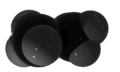 The Ethanol
-
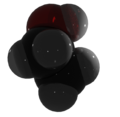 C2H6O
-
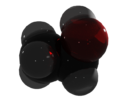 The Ethanol


| -1.1712 | 0.2997 | 0.0000 | O |
| -0.0463 | -0.5665 | 0.0000 | C |
| 1.2175 | 0.2668 | 0.0000 | C |
| -0.0958 | -1.2120 | 0.8819 | H |
| -0.0952 | -1.1938 | -0.8946 | H |
| 2.1050 | -0.3720 | -0.0177 | H |
| 1.2426 | 0.9307 | -0.8704 | H |
| 1.2616 | 0.9052 | 0.8886 | H |
| -1.1291 | 0.8364 | 0.8099 | H |
HCH bonds are assumed to be undistorded tetraherdal angle 109.5 degrees. Actually the electrons repeal each other. The HOC bond is 104.5 deg because. . .
Valence shell electron-pair repulsion theory (VSEPR theory). . .
| Atom | Radius | Relative radius |
|---|---|---|
| C | 170 pm | 1.42 |
| H | 120 pm | 1.00 |
| O | 152 pm | 1.27 |
Use CPK coloring convention, white (hydrogen), black (carbon) and red (oxygen).
Ethanol reaction with Oxygen and Air
Ethanol reaction with oxygen
The molecular weight of ethanol is g/mol, and the molar weight of oxygen is 32 g/mol. The oxygen--ethanol fuel ratio is . We need kg of oxygen to kg of ethanol. The air consists of 23.2 mass-% of oxygen, thus the air--ethanol ratio is .
The volume-% of oxygen in air is 20.9%. The volume of the bottle is ml which gives the amount of oxygen to be ml g of oxygen, which gives the amount of ethanol g ml. OR directly using air--ethanol ratio we have gram. That amount equals to ml mm3. Almost the same result using the methods. See the attached spreadsheet for detailed calculations.
The energy released by burning ethanol is 17.9 kJ/ml. Thus, ml of ethanol releases kJ of energy. This energy is converted into heat, sound and projectile motion (plus others).
| Density | At | |
|---|---|---|
| Oxygen (g) | 1.429 g/l | STP |
| Oxygen (g) | 1.314 g/l | 20 °C |
| Ethanol (l) | 789.45 g/l | 20 °C |
| Air (l) | 1.2041 g/l | 20 °C |
File:Ethanol oxygen combustion.ods
The inner diameter of the rocket bottle is 25 mm. The height of the ethanol in the cap need to be mm.
Exothermic Reaction and Energy release
Specific Heat
The energy is transferred into pressure, sound, etc. The isochoric specific heat of air is kJ/(kgK) at 18 centigrade. At 180 degrees Celsius kJ/(kgK). Thus, the energy released heats
Ideal gas law
The simplest idea is to use ideal gas law for isochoric process constant gives which gives force where is the diameter of the nozzle.
Thus, the propulsive force is
Detonation velocity
Burn rate, detonation velocity. https://en.wikipedia.org/wiki/Table_of_explosive_detonation_velocities
http://www.explosionsolutions.co.uk/110411016.pdf
https://link.springer.com/article/10.1007/s00193-015-0554-7 m/s???
Horizontal(?) accelaration due to rapidly expanding air.
Benjamin Robins:
where distance in barrel, is the initial ratio of hot gas pressure to atmospheric pressure, is the atmospheric pressure, is the cross-sectional area of the ball or bore, is the length of the barrel occupied by the powder charge before ignition.
where is the barrel diameter (the bore)
The powder change is given by where is the density of gunpowder.
--
https://www.arc.id.au/RobinsOnBallistics.html
The pressure falls as .
--
Bernoulli?
--
where
If is constant
Failed to parse (syntax error): {\displaystyle \frac12 mv^2 = A \int_0^L p dx = A \vec p L }
then
and
Projectile friction, rotational energy, heat transfer: correction factor .
The average pressure is 25% of peak pressure
--
http://closefocusresearch.com/calculating-barrel-pressure-and-projectile-velocity-gun-systems
https://www.arc.id.au/CannonBallistics.html
Maximum Flying Distance
By the conservation of energy, all explosive energy is transferred into the kinetic energy.
The distance covered by a projectile with initial velocity $v_0$ is
The drag coefficient needs to be found. For the circular disc (a coin) the drag coefficient is almost constant for all velocities (Reynold numbers). The coefficient of drag for a cylinder in this orientation is about 0.81 so long as the length to diameter ratio is greater than 2, see http://www.aerospaceweb.org/question/aerodynamics/q0231.shtml. The cone in either end gives some complications.
The drag equation for the drag force is .
Piezo Crystal
To ignite the air--ethanol mixture, we use piezo crystal. When tjhe piezo crystal is compressed, it will generate an electric charge which creates a spark.
References
https://nptel.ac.in/content/storage2/courses/123106002/MODULE%20-%20I/Lecture%201.pdf
https://www.peacesoftware.de/einigewerte/o2_e.html
http://www.users.miamioh.edu/sommerad/NSF%20Files/drag_coefficient_calculation.pdf
DRAG COEFFICIENTS FOR FLAT PLATES , SPHERES, AND CYLINDERS MOVING AT LOW REYNOLDS NUMBERS IN A VISCOUS FLUID by ALVA MERLE JONES
http://www.aerospaceweb.org/question/aerodynamics/q0231.shtml
Ethanol rockets
https://www.youtube.com/watch?v=zTwz6FGobCA Ethanol Rocket - Cool Science Experiment
https://www.youtube.com/watch?v=4s-SZypWxeg Ethanol Explosion - Cool Science Experiment


