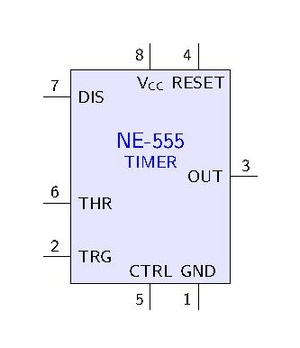
Generate pwm using ic 555

From wikiluntti
Revision as of 11:37, 3 August 2024 by Mol (talk | contribs) (→‎Method 1)

Introduction

IC 555

IC 555 is an astable multivibrator (oscillator).

Frequency: The ON time is defined by the time taken to its capacitor to charge to 1/e level through pin7 resistor, and the OFF time is the discharging time of the capacitor through pin7.

Theory

Method 1

The capacitor is charging through Failed to parse (SVG (MathML can be enabled via browser plugin): Invalid response ("Math extension cannot connect to Restbase.") from server "https://wikimedia.org/api/rest_v1/":): {\displaystyle R_1} and Failed to parse (SVG (MathML can be enabled via browser plugin): Invalid response ("Math extension cannot connect to Restbase.") from server "https://wikimedia.org/api/rest_v1/":): {\displaystyle R_2} but discharges only through Failed to parse (SVG (MathML can be enabled via browser plugin): Invalid response ("Math extension cannot connect to Restbase.") from server "https://wikimedia.org/api/rest_v1/":): {\displaystyle R_2} using IC 555. Thus Failed to parse (SVG (MathML can be enabled via browser plugin): Invalid response ("Math extension cannot connect to Restbase.") from server "https://wikimedia.org/api/rest_v1/":): {\displaystyle R_2} should be a potentiometer.

The Failed to parse (SVG (MathML can be enabled via browser plugin): Invalid response ("Math extension cannot connect to Restbase.") from server "https://wikimedia.org/api/rest_v1/":): {\displaystyle 0.01 \mu} F capacitor is to ensure that the CTRL and GND stays on the same voltage level. The CTRL pin of the 555 is to level out any fluctuations in the power supply voltage that might affect the operation.

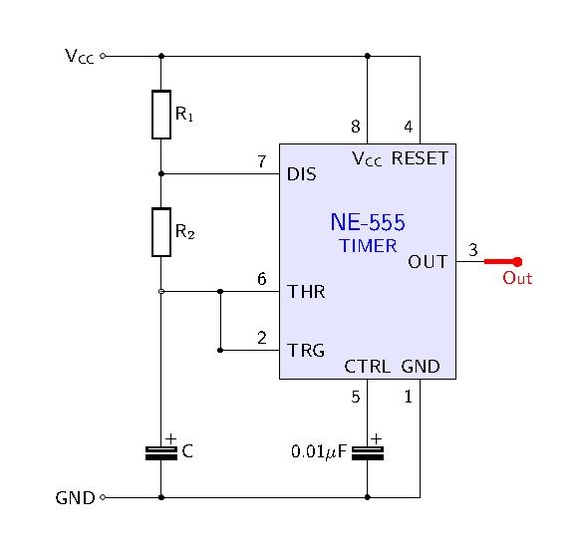
Failed to parse (SVG (MathML can be enabled via browser plugin): Invalid response ("Math extension cannot connect to Restbase.") from server "https://wikimedia.org/api/rest_v1/":): {\displaystyle \begin{align} T_\text{on} &= 0.693 (R_1 + R_2) C \\ T_\text{off} &= 0.693 R_2 C \\ f &= \frac{1.44}{(R_1 + 2R_2)C} \end{align} }

Method 2: with diodes

555 internal design and theory

See https://www.electronicshub.org/555-timer-pwm/

and the internal circuit looks like below:

References

https://www.homemade-circuits.com/how-to-use-ic-555-for-generating-pwm/

https://www.electronicshub.org/555-timer-pwm/