Pressure in atmosphere
Introduction
ISO2533:1975
The case in Toposhere (<10 km).
- Lapse rate +6.5 °C/km
- Base temp 19.0 °C
- Base atmospheric pressure 108,900 Pa equals 1.075 atm
- Base atmospheric density 1.2985 kg/m3
International Standard Atmosphere
https://en.wikipedia.org/wiki/International_Standard_Atmosphere
Consider the function in GY91's BMP280-3.3, eg at https://startingelectronics.org/tutorials/arduino/modules/pressure-sensor/
Earth's atmosphere's changes in
- Pressure
- Temperature
- Density
- Viscosity or
Hydrostatic balance The ideal gas law
Reference atmospheric model
How the ideal gas properties change (mainly) as a function of altitude (etc).
Static atmospheric model
Failed to parse (SVG (MathML can be enabled via browser plugin): Invalid response ("Math extension cannot connect to Restbase.") from server "https://wikimedia.org/api/rest_v1/":): {\displaystyle \rho = \frac{MP}{RT} } and Failed to parse (SVG (MathML can be enabled via browser plugin): Invalid response ("Math extension cannot connect to Restbase.") from server "https://wikimedia.org/api/rest_v1/":): {\displaystyle dP = -g \rho dh} (see above).
Standard atmosphere
Isothermal-barotropic approximation and scale height
Temperature and molecular weight are constant: density and pressure are exponential functions of altitude.
The US standard atmosphere
More realistic temperature function, consisting of eight data points connected by straight lines, which is---of course---an approximation.
https://en.wikipedia.org/wiki/U.S._Standard_Atmosphere
NASA Global Reference Atmospheric Models GRAM
Barometric formula
Models how the pressure of the air changes with altitude with linear temperature change.
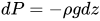
Ideal gas law Failed to parse (SVG (MathML can be enabled via browser plugin): Invalid response ("Math extension cannot connect to Restbase.") from server "https://wikimedia.org/api/rest_v1/":): {\displaystyle P = \frac{\rho}{M} R T} , where pressure Failed to parse (SVG (MathML can be enabled via browser plugin): Invalid response ("Math extension cannot connect to Restbase.") from server "https://wikimedia.org/api/rest_v1/":): {\displaystyle P} is a function of Failed to parse (SVG (MathML can be enabled via browser plugin): Invalid response ("Math extension cannot connect to Restbase.") from server "https://wikimedia.org/api/rest_v1/":): {\displaystyle n, T, V} , thus Failed to parse (SVG (MathML can be enabled via browser plugin): Invalid response ("Math extension cannot connect to Restbase.") from server "https://wikimedia.org/api/rest_v1/":): {\displaystyle P=P(n,T,V)} and the hydrostatic assumption Failed to parse (SVG (MathML can be enabled via browser plugin): Invalid response ("Math extension cannot connect to Restbase.") from server "https://wikimedia.org/api/rest_v1/":): {\displaystyle dP = - \rho g dz} are needed to derive this.
Assume Failed to parse (SVG (MathML can be enabled via browser plugin): Invalid response ("Math extension cannot connect to Restbase.") from server "https://wikimedia.org/api/rest_v1/":): {\displaystyle \frac {dp}{dh}=-\rho(h) g = - \frac{N(h)m}{V}g}
where Failed to parse (SVG (MathML can be enabled via browser plugin): Invalid response ("Math extension cannot connect to Restbase.") from server "https://wikimedia.org/api/rest_v1/":): {\displaystyle N(h)}
is the number of particles at altitude Failed to parse (SVG (MathML can be enabled via browser plugin): Invalid response ("Math extension cannot connect to Restbase.") from server "https://wikimedia.org/api/rest_v1/":): {\displaystyle h}
. The ideal gas law states that Failed to parse (SVG (MathML can be enabled via browser plugin): Invalid response ("Math extension cannot connect to Restbase.") from server "https://wikimedia.org/api/rest_v1/":): {\displaystyle pV = N R T}
, and thus Failed to parse (SVG (MathML can be enabled via browser plugin): Invalid response ("Math extension cannot connect to Restbase.") from server "https://wikimedia.org/api/rest_v1/":): {\displaystyle N = N(h) = \frac{ p(h) V }{RT} }
. Finally, we have
Failed to parse (SVG (MathML can be enabled via browser plugin): Invalid response ("Math extension cannot connect to Restbase.") from server "https://wikimedia.org/api/rest_v1/":): {\displaystyle \frac{dp}{dh} = -\frac{N(h)m}{V}g = -\frac{p(h) V}{RT} }
Assume Failed to parse (SVG (MathML can be enabled via browser plugin): Invalid response ("Math extension cannot connect to Restbase.") from server "https://wikimedia.org/api/rest_v1/":): {\displaystyle \frac {dp}{dh}=-\rho(h) g } and Failed to parse (SVG (MathML can be enabled via browser plugin): Invalid response ("Math extension cannot connect to Restbase.") from server "https://wikimedia.org/api/rest_v1/":): {\displaystyle p = \rho \frac{R}{M}T} which gives Failed to parse (SVG (MathML can be enabled via browser plugin): Invalid response ("Math extension cannot connect to Restbase.") from server "https://wikimedia.org/api/rest_v1/":): {\displaystyle \rho = \frac{pTM}{R}} and we have
Failed to parse (SVG (MathML can be enabled via browser plugin): Invalid response ("Math extension cannot connect to Restbase.") from server "https://wikimedia.org/api/rest_v1/":): {\displaystyle \frac {dp}{dh}=- g \frac{pTM}{R} }
Simplified model from Weather.gov
https://www.weather.gov/media/epz/wxcalc/pressureAltitude.pdf
Failed to parse (SVG (MathML can be enabled via browser plugin): Invalid response ("Math extension cannot connect to Restbase.") from server "https://wikimedia.org/api/rest_v1/":): {\displaystyle h = 44307.70\left( 1 - \left( \frac{p}{1013.25} \right)^{0.190284} \right) }