Diesel Cycle
Introduction
1
-
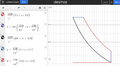
Diesel Cycle
-
Diesel Cycle


Ratio of specific heats (heat capacity ratio) is defined as

pV diagram
- Isentropic (adiabatic) expansion
- Isochoric cooling (Qout): Heat rejection. Power stroke ends, heat rejection starts.
- Isobaric compression: Exhaust
- Isobaric expansion: Intake
- Isentropic (adiabatic) compression
- Isobaric heating (Qin): Combustion of fuel (heat is added in a constant pressure;)
Engine displacement is the cylinder volume swept by all of the pistons of a piston engine, excluding the combustion chambers. A combustion chamber is part of an internal combustion engine in which the fuel/air mix is burned.
Only air is compressed, and then diesel fuel is injected directly into that hot, high-pressure air.
- Cylinder pressure: ~30–80 bar
- Injection pressure: ~1,000–2,500+ bar
Diesel Cycle and Ideal Gas
For a closed system, the total change in energy of a system is the sum of the work done and the heat added , and the reversible work done on a system by changing the volume is .

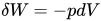
If the system is reversible and adiabatic (isentropic) , which gives


Furthermore, for any transformation of an ideal gas, it is always true that , giving

Failed to parse (SVG (MathML can be enabled via browser plugin): Invalid response ("Math extension cannot connect to Restbase.") from server "https://wikimedia.org/api/rest_v1/":): {\displaystyle dU = nC_v dT = -pdV }
Real gas: Air
1. Basic ideal gas model (good first approximation)
Air is usually approximated as an ideal gas with:
Gas constant:
R≈287 J/(kg\cdotpK) R≈287J/(kg\cdotpK) Equation of state:
p=ρRT p=ρRT
This works well at:
pressures near atmospheric temperatures roughly 200–500 K 2. “Generalized” ideal gas → temperature-dependent properties
To go beyond the simple model, you allow properties like heat capacity to vary with temperature:
Heat capacity cp(T) c p
(T)
For air, a common approximation is a polynomial:
cp(T)=a+bT+cT2+dT3 c p
(T)=a+bT+cT 2 +dT 3
Typical coefficients (for dry air, ~200–1000 K range):
a≈1005 a≈1005 b≈0.1 b≈0.1 higher-order terms small depending on fit
More accurate forms come from NASA polynomials:
cpR=a1+a2T+a3T2+a4T3+a5T4 R c p
=a 1
+a 2
T+a 3
T 2 +a 4
T 3 +a 5
T 4
These are widely used in CFD and thermodynamics.
3. Compressibility factor Z Z (real gas correction)
If you want a generalized ideal gas, you often introduce:
p=ZρRT p=ZρRT
Where:
Z=1 Z=1 → ideal gas Z≠1 Z =1 → real gas behavior
For air:
At normal conditions: Z≈1 Z≈1 At high pressure: use virial expansion Virial equation: Z=1+B(T)V+C(T)V2+⋯ Z=1+ V B(T)
+ V 2 C(T)
+⋯
Usually truncated to:
Z≈1+B(T)RTp Z≈1+ RT B(T)
p 4. Mixture-based formulation (more fundamental)
Air is a mixture mainly of:
N₂ (~78%) O₂ (~21%) Ar (~1%)
You can model it as:
R=∑iyiRi R= i ∑
y i
R i
cp=∑iyicp,i(T) c p
= i ∑
y i
c p,i
(T)
This is the most physically grounded “generalized ideal gas” model.
5. When to use which model Simple engineering → constant R,cp R,c p
Moderate accuracy (aerodynamics, engines) → cp(T) c p
(T) High pressure / high temperature → include Z Z High fidelity (CFD, combustion) → mixture + NASA polynomials Bottom line
Yes—air is commonly treated as a generalized ideal gas by:
Keeping p=ρRT p=ρRT Allowing: cp=cp(T) c p
=c p
(T) possibly Z≠1 Z =1
Realistic Diesel Cycle
-

The size of the combustion chamber of MB W211.

Ratio of specific heats γ
Failed to parse (SVG (MathML can be enabled via browser plugin): Invalid response ("Math extension cannot connect to Restbase.") from server "https://wikimedia.org/api/rest_v1/":): {\displaystyle \gamma = \frac{ \sum y_1 c_{p,i} }{ \sum y_1 ( c_{p,i} -R_u ) } }
| Condition | γ (approx.) |
|---|---|
| Stoichiometric | ~1.30–1.33 |
| Moderate lean | ~1.33–1.37 |
| Very lean (diesel) | ~1.37–1.40 |
Injection pressures
- Older systems: 200–500 bar
- Modern common-rail: 1,000–2,500 bar
- Latest systems: up to ~3,000 bar
- Air pressure in cylinder: ~30–80 bar, which is the pressure of the combustion chamber.
- Temperature: ~700–1000 K
Diesel-air Mixture
Only diesel is ejected into the cylinder. Clean air comes in during the intake stroke.
The heat capacity ratio (known as the adiabatic index) for a diesel-air mixture is typically around 1.4.
| 14.5:1 | Near-stoichiometric; good combustion efficiency but higher emissions. |
| 16:1 | Balanced performance; good power output and efficiency. |
| 18:1 | Lean burn; improved fuel economy but potential for higher NOx emissions. |
Diesel is a complicated compound, but it’s commonly approximated as a hydrocarbon like C12H23 (or C12H26). Air is about 21% O2 and 79% N2. Without nitrogen, the stoichiometric ratio is about
C12H23+17.75O2→12CO2+11.5H2O
and by including nitrogen, we get
C12H23+17.75( O2 + 3.76 N2 )→12CO2+11.5H2O + 66.74 N2.
The molar masses
- Fuel: 167 g/mol
- Air: 137.28 g/mol
And the total air needed is 17.72 x 137.28 = 2436 g, which gives air-to-fuel-ratio to
Failed to parse (SVG (MathML can be enabled via browser plugin): Invalid response ("Math extension cannot connect to Restbase.") from server "https://wikimedia.org/api/rest_v1/":): {\displaystyle AFR = \frac{2436}{167} = 14.6:1 }
MB data
Motor: OM648.
Mercedes Benz W211 (2003)
- Engine displacement: 3222 cm3 = 0.003222 m3
- Bore x Stroke: 88.0 x 88.4 mm3
- Compression Ratio: 18.0
Bore x stroke gives V = 6xπ(8.8/2)2 x 8.84 cm3 = 3225.95cm3, which is rather close.
Failed to parse (SVG (MathML can be enabled via browser plugin): Invalid response ("Math extension cannot connect to Restbase.") from server "https://wikimedia.org/api/rest_v1/":): {\displaystyle p_1 V_1^\gamma = \text{constant}_1 }


