Introduction
Ratio of specific heats (heat capacity ratio) is defined as

- Isentropic (adiabatic) expansion
- Isochoric cooling (Qout): Heat rejection. Power stroke ends, heat rejection starts.
- Isobaric compression: Exhaust
- Isobaric expansion: Intake
- Isentropic (adiabatic) compression
- Isobaric heating (Qin): Combustion of fuel (heat is added in a constant pressure;)
Engine displacement is the cylinder volume swept by all of the pistons of a piston engine, excluding the combustion chambers. A combustion chamber is part of an internal combustion engine in which the fuel/air mix is burned.
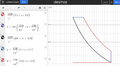
Realistic Diesel Cycle
-
The size of the combustion chamber of MB W211.
Diesel-air Mixture
The heat capacity ratio (known as the adiabatic index) for a diesel-air mixture is typically around 1.4.
heat capacity ratio Failed to parse (syntax error): {\displaystyle \gamma</gamma> |- | 14.5:1 || Near-stoichiometric; good combustion efficiency but higher emissions. |- | 16:1 || Balanced performance; good power output and efficiency. |- | 18:1 || Lean burn; improved fuel economy but potential for higher NOx emissions. |} Diesel is a complicated compound, but it’s commonly approximated as a hydrocarbon like C<sub>12</sub>H<sub>23</sub> (or C<sub>12</sub>H<sub>26</sub>). Air is about 21% O<sub>2</sub> and 79% N<sub>2</sub>. Without nitrogen, the stoichiometric ratio is about C<sub>12</sub>H<sub>23</sub>+17.75O<sub>2</sub>→12CO<sub>2</sub>+11.5H<sub>2</sub>O and by including nitrogen, we get C<sub>12</sub>H<sub>23</sub>+17.75( O<sub>2</sub> + 3.76 N<sub>2</sub> )→12CO<sub>2</sub>+11.5H<sub>2</sub>O + 66.74 N<sub>2</sub>. The molar masses * Fuel: 167 g/mol * Air: 137.28 g/mol And the total air needed is 17.72 x 137.28 = 2436 g, which gives air-to-fuel-ratio to <math> AFR = \frac{2436}{167} = 14.6:1 }
MB data
Mercedes Benz W211 (2003)
- Engine displacement: 3222 cm3
- Bore x Stroke: 88.0 x 88.4 mm3
- Compression Ratio: 18.0
Bore x stroke gives V = 6xπ(8.8/2)2 x 8.84 cm3 = 3225.95cm3, which is rather close.
1
1
1
|