Brachistochrone

From wikiluntti
Revision as of 22:59, 16 February 2021 by Mol (talk | contribs) (→‎No Friction)

Introduction

To find the shape of the curve which the time is shortest possible. . .

Theory

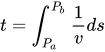
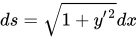
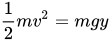
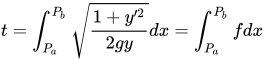
The time from to is where is the Pythagorean distance measure and is determined from the the law of conservation of energy . giving . Plugging these in, we get Failed to parse (SVG (MathML can be enabled via browser plugin): Invalid response ("Math extension cannot connect to Restbase.") from server "https://wikimedia.org/api/rest_v1/":): {\displaystyle t = \int_{P_a}^{P_b} \sqrt{\frac{1+y'^{2}}{2gy}}dx = \int_{P_a}^{P_b} f dx} , where Failed to parse (SVG (MathML can be enabled via browser plugin): Invalid response ("Math extension cannot connect to Restbase.") from server "https://wikimedia.org/api/rest_v1/":): {\displaystyle f=f(y,y')} is the function subject to variational consideration.

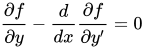
According to the Euler--Lagrange differential equation the stationary value is to be found, if E-L equation Failed to parse (SVG (MathML can be enabled via browser plugin): Invalid response ("Math extension cannot connect to Restbase.") from server "https://wikimedia.org/api/rest_v1/":): {\displaystyle \frac{\partial f}{\partial y} - \frac{d}{d x}\frac{\partial f}{\partial y'} = 0} is satisfied.

No Friction

We get Failed to parse (SVG (MathML can be enabled via browser plugin): Invalid response ("Math extension cannot connect to Restbase.") from server "https://wikimedia.org/api/rest_v1/":): {\displaystyle \frac{\partial f}{\partial y'} = \frac{\partial }{\partial y'} \sqrt{\frac{1+y'^{2}}{2gy}} = \frac1{\sqrt{2gy}} \frac{\partial }{\partial y'} \sqrt{1+y'^{2}} = \frac{2y'}{\sqrt{2gy}} \frac1 {2\sqrt{1+y'^{2}}} } . Since Failed to parse (SVG (MathML can be enabled via browser plugin): Invalid response ("Math extension cannot connect to Restbase.") from server "https://wikimedia.org/api/rest_v1/":): {\displaystyle f} does not depend on , we may use the simplified E--L formula .

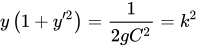
Thus, we have So we have and multiplying this with the denominator and rearring, we have by redefining the constant. The standard solution to this equation is given by Failed to parse (syntax error): {\displaystyle \begin{align*} x &= \frac12 k^2( \theta - \sin\theta) \\ y &= \frac12 k^2( 1 - \cos\theta) \end{align*} and is the equation of a cycloid. }


Friction

Rolling Ball

References

https://mathworld.wolfram.com/BrachistochroneProblem.html

https://physicscourses.colorado.edu/phys3210/phys3210_sp20/lecture/lec04-lagrangian-mechanics/