Brachistochrone: Difference between revisions

From wikiluntti
Line 58: Line 58:
y &= \frac12 k^2( 1 - \cos\theta)
\end{align}
\end{align}
and is the equation of a cycloid.
</math>
</math>
and is the equation of a cycloid.


=== Friction ===
=== Friction ===

Revision as of 23:00, 16 February 2021

Introduction

To find the shape of the curve which the time is shortest possible. . .

Theory

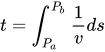
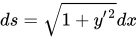
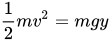
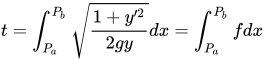
The time from to is where is the Pythagorean distance measure and is determined from the the law of conservation of energy Failed to parse (Conversion error. Server ("https://wikimedia.org/api/rest_") reported: "Cannot get mml. Server problem."): {\displaystyle {\frac {1}{2}}mv^{2}=mgy} . giving . Plugging these in, we get , where Failed to parse (SVG (MathML can be enabled via browser plugin): Invalid response ("Math extension cannot connect to Restbase.") from server "https://wikimedia.org/api/rest_v1/":): {\displaystyle f=f(y,y')} is the function subject to variational consideration.

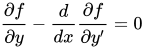
According to the Euler--Lagrange differential equation the stationary value is to be found, if E-L equation Failed to parse (SVG (MathML can be enabled via browser plugin): Invalid response ("Math extension cannot connect to Restbase.") from server "https://wikimedia.org/api/rest_v1/":): {\displaystyle \frac{\partial f}{\partial y} - \frac{d}{d x}\frac{\partial f}{\partial y'} = 0} is satisfied.

No Friction

We get Failed to parse (SVG (MathML can be enabled via browser plugin): Invalid response ("Math extension cannot connect to Restbase.") from server "https://wikimedia.org/api/rest_v1/":): {\displaystyle \frac{\partial f}{\partial y'} = \frac{\partial }{\partial y'} \sqrt{\frac{1+y'^{2}}{2gy}} = \frac1{\sqrt{2gy}} \frac{\partial }{\partial y'} \sqrt{1+y'^{2}} = \frac{2y'}{\sqrt{2gy}} \frac1 {2\sqrt{1+y'^{2}}} } . Since Failed to parse (SVG (MathML can be enabled via browser plugin): Invalid response ("Math extension cannot connect to Restbase.") from server "https://wikimedia.org/api/rest_v1/":): {\displaystyle f} does not depend on Failed to parse (SVG (MathML can be enabled via browser plugin): Invalid response ("Math extension cannot connect to Restbase.") from server "https://wikimedia.org/api/rest_v1/":): {\displaystyle x} , we may use the simplified E--L formula Failed to parse (SVG (MathML can be enabled via browser plugin): Invalid response ("Math extension cannot connect to Restbase.") from server "https://wikimedia.org/api/rest_v1/":): {\displaystyle f-y' \frac{\partial f}{\partial y'}= \text{Constant}} .

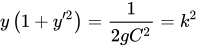
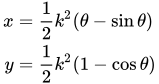
Thus, we have Failed to parse (SVG (MathML can be enabled via browser plugin): Invalid response ("Math extension cannot connect to Restbase.") from server "https://wikimedia.org/api/rest_v1/":): {\displaystyle f - y' \frac{\partial f}{\partial y'} = \sqrt{ \frac{1+y'{^2}}{2gy} } - \frac{y'{^2}}{\sqrt{2gy} \sqrt{1+y'^{2}}} = C } So we have Failed to parse (SVG (MathML can be enabled via browser plugin): Invalid response ("Math extension cannot connect to Restbase.") from server "https://wikimedia.org/api/rest_v1/":): {\displaystyle \frac{1+y'{^2}}{\sqrt{2gy(1+y'{^2})}} - \frac{y'{^2}}{\sqrt{2gy} \sqrt{1+y'^{2}}} = \frac{1}{\sqrt{2gy(1+y'{^2})}} = C } and multiplying this with the denominator and rearring, we have Failed to parse (SVG (MathML can be enabled via browser plugin): Invalid response ("Math extension cannot connect to Restbase.") from server "https://wikimedia.org/api/rest_v1/":): {\displaystyle y\left( 1 + y'^{2}\right) = \frac1{2gC^2} = k^2 } by redefining the constant. The standard solution to this equation is given by Failed to parse (SVG (MathML can be enabled via browser plugin): Invalid response ("Math extension cannot connect to Restbase.") from server "https://wikimedia.org/api/rest_v1/":): {\displaystyle \begin{align} x &= \frac12 k^2( \theta - \sin\theta) \\ y &= \frac12 k^2( 1 - \cos\theta) \end{align} } and is the equation of a cycloid.

Friction

Rolling Ball

References

https://mathworld.wolfram.com/BrachistochroneProblem.html

https://physicscourses.colorado.edu/phys3210/phys3210_sp20/lecture/lec04-lagrangian-mechanics/