Sinuosity of Kemijoki: Difference between revisions
(→Theory) |
|||
| Line 24: | Line 24: | ||
== Fractal Dimension == | == Fractal Dimension == | ||
The fractal dimension is defined by <math>N = \epsilon^{-d}</math> which gives <math>d = - \frac{\log N}{\log \epsilon}</math>. | The fractal dimension is defined by <math>N = \epsilon^{-d}</math> which gives <math>d = - \frac{\log N}{\log \epsilon}</math>. <math>N</math> is the number of elements, also number of strides, and <math>\epsilon</math> | ||
Revision as of 09:48, 27 April 2026
Introduction
Use Python to estimate the sinuosity of Kemijoki.
The river was obtained from https://download.geofabrik.de/europe/finland.html but only one river (Kemijoki) with one branch is used. The extracting method is described elsewhere.
Kemijoki
-

Kemijoki is 550 km long according to Wikipedia. This dataset contains 500.20 km of river.
-
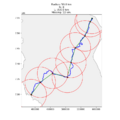
Kemijoki measured with 50 km measure stick. The distance doesn't exactly match up, and the last 12 km is missing.
-

By cutting the measuring stick to half, we get one measure (25 km) more length. It still skips many of the meandering.
-

More distance and curves are achieved.
-

Missing only 1 km, but because the river curves so eccentric, it skips many kilmometers. By zooming it is easy to see that a lot of meandering is missing.
-
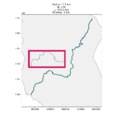
Taking 2.5 km out of the measuring stick, we gain 30 km of river length.
-
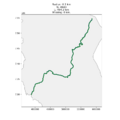
Finally, using a 100 m strides we will arrive rather close to the GIS measure.
-
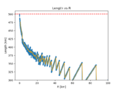
The length vs radius. Note the sawtooth phenomena.


Theory
Douglas-Peucker simplification at different tolerances
Fractal Dimension
The fractal dimension is defined by which gives . is the number of elements, also number of strides, and


