Diesel Cycle: Difference between revisions
From wikiluntti
| Line 32: | Line 32: | ||
{| class="wikitable" | {| class="wikitable" | ||
|+ | |+ heat capacity ratio <math>\gamma</gamma> | ||
|- | |- | ||
| 14.5:1 || Near-stoichiometric; good combustion efficiency but higher emissions. | | 14.5:1 || Near-stoichiometric; good combustion efficiency but higher emissions. | ||
Revision as of 22:35, 23 March 2026
Introduction
-
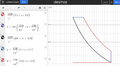
Diesel Cycle
-
Diesel Cycle


Ratio of specific heats (heat capacity ratio) is defined as

- Isentropic (adiabatic) expansion
- Isochoric cooling (Qout): Heat rejection. Power stroke ends, heat rejection starts.
- Isobaric compression: Exhaust
- Isobaric expansion: Intake
- Isentropic (adiabatic) compression
- Isobaric heating (Qin): Combustion of fuel (heat is added in a constant pressure;)
Engine displacement is the cylinder volume swept by all of the pistons of a piston engine, excluding the combustion chambers. A combustion chamber is part of an internal combustion engine in which the fuel/air mix is burned.
Realistic Diesel Cycle
-

The size of the combustion chamber of MB W211.

Diesel-air Mixture
The heat capacity ratio (known as the adiabatic index) for a diesel-air mixture is typically around 1.4.


