Diesel Cycle: Difference between revisions
From wikiluntti
| Line 18: | Line 18: | ||
<gallery> | <gallery> | ||
Cylinder.png| The size of the combustion chamber of | Cylinder.png| The size of the combustion chamber of MB W211. | ||
</gallery> | </gallery> | ||
Revision as of 22:16, 23 March 2026
Introduction
-
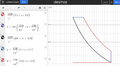
Diesel Cycle
-
Diesel Cycle


- Isentropic (adiabatic) expansion
- Isochoric cooling (Qout): Heat rejection. Power stroke ends, heat rejection starts.
- Isobaric compression: Exhaust
- Isobaric expansion: Intake
- Isentropic (adiabatic) compression
- Isobaric heating (Qin): Combustion of fuel (heat is added in a constant pressure;)
Engine displacement is the cylinder volume swept by all of the pistons of a piston engine, excluding the combustion chambers. A combustion chamber is part of an internal combustion engine in which the fuel/air mix is burned.
Realistic Diesel Cycle
-

The size of the combustion chamber of MB W211.

Mercedes Benz W211 (2003)
- Engine displacement: 3222 cm3
- Bore x Stroke: 88.0 x 88.4 mm3
- Compression Ratio: 18.0
Bore x stroke gives V = 6xπ(8.8/2)2 x 8.84 cm3 = 3225.95cm3, which is rather close.


