NTC calibration and multiple temperature sensors: Difference between revisions
From wikiluntti
| Line 36: | Line 36: | ||
=== LM35DZ == | === LM35DZ == | ||
== | == GY-91 == | ||
Revision as of 15:42, 6 September 2023
Introduction
Calibration of NTC sensors and different
NTC
Note that the temperature of the sensor rises when the current supplies through the resistor. The NTC is nonlinear; see below Calibration.
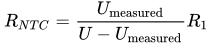
Negative Temperature Coefficient, NTCLE100E3101JB0 or similar (MF52B NTC Thermistor). The NTC is connected in series with a "shunt" resistor , see Measurement of resistors: voltage divider. Usually is used. The total resistance of the circuit is , which gives



Calibrating: Steinhart-Hart Equation
A nonlinear Steinhart-Hart equation is widely used

Calibrating using known datapoints
Though the NTC sensor is nonlinear, locally it will be linear. Thus by using some known datapoints the temperature can be estimated.


