NTC calibration and multiple temperature sensors: Difference between revisions
| (17 intermediate revisions by the same user not shown) | |||
| Line 33: | Line 33: | ||
=== | == B equation == | ||
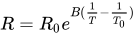
Steinhart--Hart equation can be derived from extending the B parameter equation to an infinite series. | |||
<math> | |||
R = R_0 e^{B(\frac1T - \frac1{T_0})} | |||
</math> | |||
== Steinhart-Hart Equation == | |||
A nonlinear Steinhart-Hart equation is widely used | A nonlinear Steinhart-Hart equation is widely used | ||
| Line 46: | Line 55: | ||
<math> | <math> | ||
\rho^{-1} = F(T) e^{- \Delta E/ | \rho^{-1} = F(T) e^{- \beta \Delta E/2} | ||
</math> | </math> | ||
where <math>\Delta E</math> is the energy gap. However, the thermistors does not have sharply defined energy bands, and thus <math>\Delta E</math> is in doubt. Steinhart and Hart simply used empirical curve fitting with following criteria: | where <math>\Delta E</math> is the energy gap. However, the thermistors does not have sharply defined energy bands, and thus <math>\Delta E</math> is in doubt. Steinhart and Hart simply used empirical curve fitting with following criteria: | ||
| Line 53: | Line 62: | ||
# linear fitting procedures: least squares may be used. | # linear fitting procedures: least squares may be used. | ||
etc. | etc. | ||
From B equation | |||
<math> | |||
R = R_0 e^{B(\frac1T - \frac1{T_0})} | |||
</math> | |||
we have | |||
<math> | |||
\frac1T = \frac1{T_0} + \frac1B \ln(R/R_0) = a_0 + a_1 \ln (R/R_0) | |||
</math> | |||
and expand it to infinite series, but use only some first terms. | |||
=== Calibrating using known datapoints === | === Calibrating using known datapoints === | ||
[[File:Thermistor calibrate desmos.png|thumb|Thermistor calibration using three measused points]] | |||
Though the NTC sensor is nonlinear, locally it will be linear. Thus by using some known datapoints the temperature can be estimated. | Though the NTC sensor is nonlinear, locally it will be linear. Thus by using some known datapoints the temperature can be estimated. | ||
Some known datapoints: | Example. Some known datapoints: R2 = 16200 | ||
* boiling water 100 deg | * boiling water 100 deg gives R2 = 16200 | ||
* room temperature | * room temperature 24 deg R2 = 5885 | ||
* freezing point of water | * freezing point of water R2 = 533 | ||
== LM35DZ == | |||
== GY-91 == | == GY-91 == | ||
| Line 108: | Line 131: | ||
f_{M-B}(\epsilon)=e^{-\beta(\epsilon-\mu)} | f_{M-B}(\epsilon)=e^{-\beta(\epsilon-\mu)} | ||
</math> | </math> | ||
The electron density is calculated as | |||
<math> | |||
n = \int_{-\infty}^\infty g_c(E) f(E) dE | |||
</math> | |||
where <math>g_c(E)</math> is the density of states. | |||
With NTC thermistors, resistance decreases as temperature rises; usually due to an increase in conduction electrons bumped up by thermal agitation from the valence band (Wikipedia). | With NTC thermistors, resistance decreases as temperature rises; usually due to an increase in conduction electrons bumped up by thermal agitation from the valence band (Wikipedia). | ||
| Line 113: | Line 146: | ||
Intrinsic conduction: <math>\ln RT = A + B/T</math>. It was found that <math>B</math> (<math>\beta</math>) is not constant but dependent on temperature. | |||
Intrinsic conduction (no doped): <math>\ln RT = A + B/T</math>. It was found that <math>B</math> (<math>\beta</math>) is not constant but dependent on temperature. For intrinsic <math>n=p</math> giving | |||
<math> | |||
\begin{align} | |||
N_C e^{\beta(E_f - E_c)} &= N_v e^{\beta(E_v - E_f)}\\ | |||
E_f &= \frac12 (E_c + E_v) + \frac12 \beta \ln \frac{N_v}{N_c} | |||
\end{align} | |||
</math> | |||
and if <math>N_v\approx N_c</math>, then <math>E_f</math> is in the middle of the gap giving | |||
<math> | |||
n = p = \sqrt{N_c N_v}e^{-\beta \Delta E/2 } | |||
</math> | |||
This will give | |||
<math> | |||
\rho_e = \frac1{B e^{-\beta \Delta E/2}} = Ae^{\beta \Delta E/2} | |||
</math> | |||
which gives | |||
<math> | |||
\ln \rho_e = \ln (\beta \Delta E/2 ) + \ln A | |||
</math> | |||
| Line 121: | Line 180: | ||
R = R_\textrm{ref} e^{A + B/T + C/T^2 + D/T^3} | R = R_\textrm{ref} e^{A + B/T + C/T^2 + D/T^3} | ||
</math> | </math> | ||
== References == | == References == | ||
| Line 129: | Line 187: | ||
* https://community.element14.com/challenges-projects/design-challenges/experimenting-with-thermistors/b/challenge-blog/posts/blog-4-characterising-thermistors-an-inconvenient-truth-taking-things-to-the-fifth-degree | * https://community.element14.com/challenges-projects/design-challenges/experimenting-with-thermistors/b/challenge-blog/posts/blog-4-characterising-thermistors-an-inconvenient-truth-taking-things-to-the-fifth-degree | ||
* https://electronics.stackexchange.com/questions/51865/how-to-get-a-b-and-c-values-for-this-thermistor | * https://electronics.stackexchange.com/questions/51865/how-to-get-a-b-and-c-values-for-this-thermistor | ||
* https://www.newport.com/medias/sys_master/images/images/h67/hc1/8797049487390/AN04-Thermistor-Calibration-and-Steinhart-Hart.pdf | |||
* https://www.tdk-electronics.tdk.com/download/531116/19643b7ea798d7c4670141a88cd993f9/%20pdf-general-technical-information.pdf | |||
* https://courses.cit.cornell.edu/ece533/Lectures/handout1.pdf | |||
* http://www.engineeringphysics.weebly.com/uploads/8/2/4/3/8243106/unit_iv_semiconductors.pdf | |||
Latest revision as of 09:14, 28 March 2024
Introduction
Calibration of NTC sensors and different
NTC thermistor elements come in many styles [4] such as axial-leaded glass-encapsulated (DO-35, DO-34 and DO-41 diodes), glass-coated chips, epoxy-coated with bare or insulated lead wire and surface-mount, as well as thin film versions. (Wikipedia)
NTC
Note that the temperature of the sensor rises when the current supplies through the resistor. The NTC is nonlinear; see below Calibration.
Negative Temperature Coefficient, NTCLE100E3101JB0 or similar (MF52B NTC Thermistor). The NTC is connected in series with a "shunt" resistor , see Measurement of resistors: voltage divider. Usually is used. The total resistance of the circuit is , which gives




or

depending on the circuit. So check the circuit.
B equation
Steinhart--Hart equation can be derived from extending the B parameter equation to an infinite series.
Steinhart-Hart Equation
A nonlinear Steinhart-Hart equation is widely used

The parameters , and can be obtained, if the resistance of three (3) temperatures is known.


Steinhart-Hart Equation was found in 1968.
where is the energy gap. However, the thermistors does not have sharply defined energy bands, and thus is in doubt. Steinhart and Hart simply used empirical curve fitting with following criteria:


- a single smoothly varying relationship for the entire range.
- no plus-minus effect.
- linear fitting procedures: least squares may be used.

etc.
From B equation we have
and expand it to infinite series, but use only some first terms.

Calibrating using known datapoints

Though the NTC sensor is nonlinear, locally it will be linear. Thus by using some known datapoints the temperature can be estimated.
Example. Some known datapoints: R2 = 16200
- boiling water 100 deg gives R2 = 16200
- room temperature 24 deg R2 = 5885
- freezing point of water R2 = 533
LM35DZ
GY-91
Some Semiconductor Physics
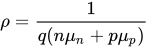
Resistivity: where is the density or number of charge carriers, . Electrons are spin-1/2 particles and thus they obey Fermi-Dirac statistics. The electron current through a perpendicular semiconductor sample is


and the total current is the sum of electrons and holes; . The proportionality constant is called conductivity, and its inverse is the resistivity:

Usually only other ( or ) is dominant.


Obs! The term is called electron mobility and is defined by Newton II law:

The Fermi energy is the highest energy of the collection of electrons at T=0 Kelvin is the "primitive" approximation. Fermi-Dirac distribution can be approximated (exercise: when) as Maxwell-Boltzmann exponential


The electron density is calculated as

where is the density of states.

With NTC thermistors, resistance decreases as temperature rises; usually due to an increase in conduction electrons bumped up by thermal agitation from the valence band (Wikipedia).
Intrinsic conduction (no doped): . It was found that () is not constant but dependent on temperature. For intrinsic giving


and if , then is in the middle of the gap giving


This will give

which gives

Target:

References
- S. Steinhart and S.R. Hart. 1968. "Calibration Curves for Thermistors," Deep-Sea Research 15: 497
- https://www.qtisensing.com/wp-content/uploads/Beta-vs-Steinhart-Hart.pdf
- https://community.element14.com/challenges-projects/design-challenges/experimenting-with-thermistors/b/challenge-blog/posts/blog-4-characterising-thermistors-an-inconvenient-truth-taking-things-to-the-fifth-degree
- https://electronics.stackexchange.com/questions/51865/how-to-get-a-b-and-c-values-for-this-thermistor
- https://www.newport.com/medias/sys_master/images/images/h67/hc1/8797049487390/AN04-Thermistor-Calibration-and-Steinhart-Hart.pdf
- https://www.tdk-electronics.tdk.com/download/531116/19643b7ea798d7c4670141a88cd993f9/%20pdf-general-technical-information.pdf
- https://courses.cit.cornell.edu/ece533/Lectures/handout1.pdf
- http://www.engineeringphysics.weebly.com/uploads/8/2/4/3/8243106/unit_iv_semiconductors.pdf


