Pressure in atmosphere: Difference between revisions
| (10 intermediate revisions by the same user not shown) | |||
| Line 50: | Line 50: | ||
https://en.wikipedia.org/wiki/U.S._Standard_Atmosphere | https://en.wikipedia.org/wiki/U.S._Standard_Atmosphere | ||
=== NRLMSISE-00 === | |||
Is an empirical, global reference atmospheric model of the Earth from ground to space. | |||
=== NASA Global Reference Atmospheric Models GRAM === | === NASA Global Reference Atmospheric Models GRAM === | ||
== Barometric formula == | == Barometric formula == | ||
https://en.wikipedia.org/wiki/Barometric_formula | |||
Models how the pressure of the air changes with altitude with linear temperature change. | Models how the pressure of the air changes with altitude with linear temperature change. | ||
| Line 60: | Line 66: | ||
<math>P = \frac{\rho}{M} R T</math>, where pressure <math>P</math> is a function of <math>n, T, V</math>, thus <math>P=P(n,T,V)</math> and the hydrostatic assumption <math>dP = - \rho g dz</math> are needed to derive this. | <math>P = \frac{\rho}{M} R T</math>, where pressure <math>P</math> is a function of <math>n, T, V</math>, thus <math>P=P(n,T,V)</math> and the hydrostatic assumption <math>dP = - \rho g dz</math> are needed to derive this. | ||
Assume <math>\frac {dp}{dh}=-\rho(h) g </math> and <math>p = \rho \frac{R}{M}T</math> which gives <math>\rho = \frac{pM}{RT}</math> and we have | |||
<math> | |||
\frac {dp}{dh}=- g \frac{pM}{RT} | |||
</math> | |||
Actually, both <math>p</math> and <math>T</math> are dependent on altitude <math>h</math>. Thus, we will assume linear dependency on temperature <math>T = T_0 - Lh</math>, and we have | |||
<math> | <math> | ||
\frac{dp}{dh} = -\frac{ | \begin{align} | ||
\frac {dp}{dh}&=- g \frac{pM}{R(T_0 - Lh)} \\ | |||
\frac {dp}{p}&=- g \frac{M}{R(T_0 - Lh)} dh \\ | |||
\ln p &= \frac{gM}{RL} \ln(T_0 - hL) + C \\ | |||
p &= p_0 \left( T_0 - hL \right)^{\frac{gM}{RL}} | |||
\end{align} | |||
</math> | </math> | ||
and this gives for altitude <math>h</math> | |||
<math> | |||
h = \frac{T_0 - \left( \frac{p}{p_0}\right)^{\frac{LR}{gM} }}{L} | |||
</math> | |||
Latest revision as of 18:14, 30 August 2023
Introduction
ISO2533:1975
The case in Toposhere (<10 km).
- Lapse rate +6.5 °C/km
- Base temp 19.0 °C
- Base atmospheric pressure 108,900 Pa equals 1.075 atm
- Base atmospheric density 1.2985 kg/m3
International Standard Atmosphere
https://en.wikipedia.org/wiki/International_Standard_Atmosphere
Consider the function in GY91's BMP280-3.3, eg at https://startingelectronics.org/tutorials/arduino/modules/pressure-sensor/
Earth's atmosphere's changes in
- Pressure
- Temperature
- Density
- Viscosity or


Hydrostatic balance The ideal gas law


Reference atmospheric model
How the ideal gas properties change (mainly) as a function of altitude (etc).
Static atmospheric model
and (see above).


Standard atmosphere
Isothermal-barotropic approximation and scale height
Temperature and molecular weight are constant: density and pressure are exponential functions of altitude.
The US standard atmosphere
More realistic temperature function, consisting of eight data points connected by straight lines, which is---of course---an approximation.
https://en.wikipedia.org/wiki/U.S._Standard_Atmosphere
NRLMSISE-00
Is an empirical, global reference atmospheric model of the Earth from ground to space.
NASA Global Reference Atmospheric Models GRAM
Barometric formula
https://en.wikipedia.org/wiki/Barometric_formula
Models how the pressure of the air changes with altitude with linear temperature change.
Ideal gas law , where pressure is a function of , thus and the hydrostatic assumption are needed to derive this.


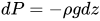
Assume and which gives and we have


Actually, both and are dependent on altitude . Thus, we will assume linear dependency on temperature , and we have




and this gives for altitude Failed to parse (SVG (MathML can be enabled via browser plugin): Invalid response ("Math extension cannot connect to Restbase.") from server "https://wikimedia.org/api/rest_v1/":): {\displaystyle h}
Failed to parse (SVG (MathML can be enabled via browser plugin): Invalid response ("Math extension cannot connect to Restbase.") from server "https://wikimedia.org/api/rest_v1/":): {\displaystyle h = \frac{T_0 - \left( \frac{p}{p_0}\right)^{\frac{LR}{gM} }}{L} }
Simplified model from Weather.gov
https://www.weather.gov/media/epz/wxcalc/pressureAltitude.pdf


